

Disclosure Day. Yikes
Steven Spielberg’s lauded return to sci-fi is possibly the worst movie of the year so far

A Gooner friend of mine missed the Arsenal victory at the end of last season because he was in a rep cinema watching Joachim Trier’s The Worst Person In The World for the first time. For those who don’t follow English football, Arsenal’s close title rivals Manchester City were playing sixth-placed Bournemouth and needed a win to stay in the race; surely, my friend reasoned, they’d blow them away as easily as they had so many other teams throughout the season. No such luck – City dropped points in a 1-1 draw, and he emerged from 128 minutes of millennial Norwegian bildungsroman to find his team had won the Prem for the first time in 22 years while he was busy pondering Renate Reinsve and Anders Danielsen Lie. Gutting.
I tell you this because I myself missed the first half of England’s opening World Cup game against Croatia this week to sit through Steven Spielberg’s Disclosure Day. The stakes were much, much higher for Arsenal. My friend missed the very moment they won the league, something he’d been dreaming about for decades. He still got a better deal with The Worst Person In The World. Disclosure Day is dire. I wish I’d watched England instead.

Long-time Spielberg fans will recognise the premise of the film, which is essentially the same as that in War of the Worlds, E.T., A.I. Artificial Intelligence, Minority Report, hell, even Jurassic Park: how, the film asks, would humanity react to encountering great and possibly otherworldly scientific power? And how might we confront or use that power?
Disclosure Day opens with a chase. Crumpled Englishman Josh O’Connor, here Yankified and shorn of all usual charm because of it, plays Dr Daniel Kellner, a researcher working to expose the capture and mistreatment of various aliens which have been apprehended by the US government over the previous 79 years.1 He’s being pursued by an entire network of J. Crew-wearing baddies led by Colin Firth’s rather natty Noah Scanlon (as the villain, he’s the only one of the film’s three British leads who is allowed to retain his Home Counties accent; this makes him at least a tad threatening, I suppose). Scanlon’s organisation, an off-the-books government agency, is known as Wardex.
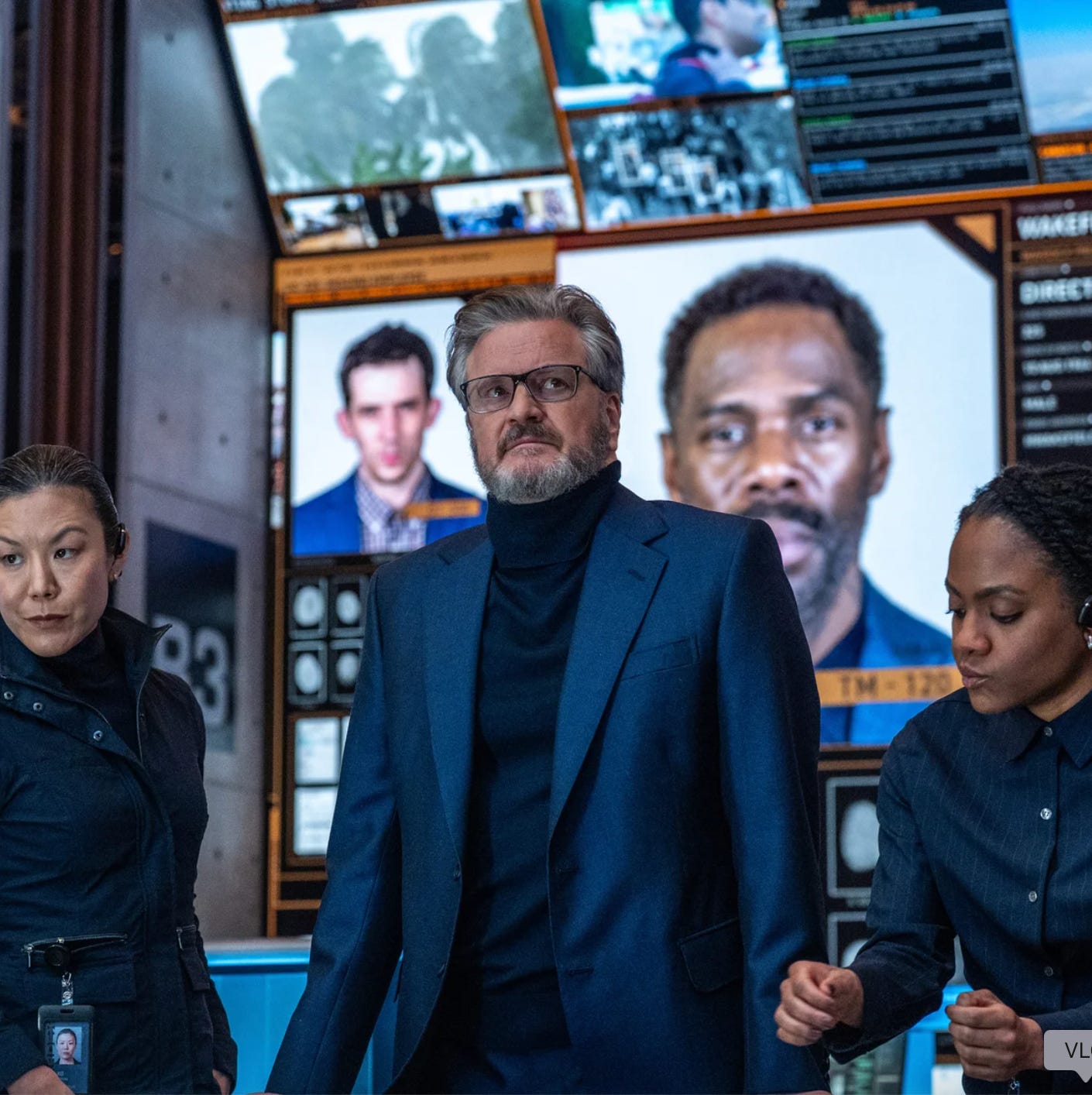
Wardex’s crimes? In footage that Kellner shows his situationship Jane – played here by Bono’s pouty daughter Eve Hewson – Scanlon and his government goons inject a shrieking captive alien with gram upon gram of, I shit you not, pure ketamine.2 The poor xeno wails and sounds a bit like Gollum when he’s being tortured by orcs. (“SHIRE!!! BAGGINS!!!” et cetera.) Jane is horrified, and agrees to help Kellner. All this information is hidden on some sort of macguffin memory stick geegaw that everyone is chasing across the middle of America.
Meanwhile, local Kansas City news weather reporter Margaret Fairchild (a plasticky Emily Blunt) is visited one day over breakfast by a mysterious red cardinal.3 This encounter somehow gives her an inexplicable, super-empathic ability to understand the problems of anyone she’s talking to, and to tell them exactly what they need to hear, almost as though she can read their mind. It also enables her to speak a mysterious language of sorts, which she proceeds to speak on-air that morning. (This is the bit that you probably remember from the trailer.) It sounds like someone speaking Xhosa while giving a particularly horrible blow job.
Fairchild is also compelled to try to make her way to Kellner, intuiting that she needs to contact him for reasons she doesn’t know. As their paths converge and Wardex closes in, the race is on to disclose – there we go – the truth about the alien programme and the fact that humanity is not alone in the universe.

It’s not a bad premise, really. Several of the ingredients here lifted from the well-stocked sci-fi larder, including crop circles and astral projection, offer really good potential for set-piece moments and visuals. There are likewise a handful of excellent action sequences, albeit spoiled by O’Connor being forced to exclaim “Oh, gahd, oh, whaht am I doing, oh gahd” over and over again in a sort of sub-Marvel attempt at comedy as he e.g. hijacks one of those massive American SUVs with the blacked-out windows and drives it straight through a rickety clapboard house. There was certainly potential.
The CGI animals were a problem, though. Deer have always been a problem for people tasked with animating them – they have to be light on their feet while still very heavy animals, and studios seem unable to rig their CGI models in the right balance – while the cardinal, racoon and other beasties that appear in front of Kellner and Fairchild throughout the film also reside firmly in the Hallmark Channel uncanny valley.4
The film is also way too slow. Scenes drag. But, more than anything else, it was David Koepp’s script that was the problem. Koepp is a longtime collaborator of Spielberg’s, and while the latter came up with the initial 50-page story, Koepp himself put it down at length on paper (or, apparently, on iPad).
Maybe I noticed this more because I watched the film with closed captions in an accessible screening, but it is absolutely heaving with clunky expositionary dialogue.5 Ironically, given the captions, there’s so much plot and characterisation spoken aloud in Disclosure Day that it would have been more suitable for a screening for the blind than the deaf: just so many questions in so many rooms. For at least the first hour of this film, everyone tells everyone else every detail of their life story in every scene. When I looked back at my handwritten notes I found I had written and underlined, several times, the phrase “Exposition Day”.6
I don’t want to spoil the whole premise beyond the first 30-odd minutes of Disclosure Day’s 145, so allow me to give a handful of examples from within the main characters’ backstories. In the film’s very first scene, Kellner and Jane flee from the goons in a stolen car while he desperately tries to call an ally. “These are satellite burner phones, we only use them once,” O’Connor breathlessly explains to her – and the audience, who presumably can’t be trusted to fill that information in themselves.
Later, they take refuge in a convent, where Jane knows the Mother Superior. “You were a nun?” Kellner asks her, incredulous. “We’ve had sex, so what do you think?” replies Jane. As the viewer, I truly don’t know; you can be a nun and then have sex with someone later, so? But it’s another heavy-handed way of establishing their relationship. Jane then asks her own question about Kellner’s association with the villains: “How long did you work for these people?” The reply: “Ever since I got out of prison eight years ago.” The dialogue sounds like characters reciting lists of facts about themselves.
Last one, I promise: when Fairchild, Emily Blunt’s newsreader, tells her boyfriend7 she wants to relocate for a second time in two years, from Kansas City to somewhere else (she doesn’t know where yet), he throws up his hands and exclaims, “We were in Dallas last year!” This is perhaps the best example of poorly hidden dialogue-as-exposition, the cardinal sin of scriptwriting: having two characters tell each other things they both already know.
Elsewhere, characters literally state their personal beliefs to one another, and ask each other lists of questions whose answers reveal their backstories. The weirdest part of all of this is that Fairchild can literally read minds and yet she and others around her who are aware of this ability still tell each other things they both know, and which they both know they both know.
Perhaps I digress, but who forgot “Show, don’t tell?”

Is this style of writing symptomatic of that Netflix problem that we’ve all heard of? The way scriptwriters are allegedly told to write didactically, bonking you on the head with exposition and having a character announce what is happening in the film aloud, so that viewers can still follow the plot while looking at their phones? I don’t think it is, personally, because I don’t think someone like Koepp, writing for someone like Spielberg, would necessarily face that pressure – but I’m not an expert, by any means.
Astonishingly, major voices in film crit media have come out to bat for this movie. The Big Picture – love em, but they’re so constitutionally positive about movies they would find something good to say about Triumph of the Will – called Disclosure Day “a massive philosophical reckoning” for Spielberg, and “very rich”. Host Sean Fennessey compared watching the film to a religious experience. (To be fair, he and co-host Amanda Dobbins also admitted it had script flaws, before rushing back to talk about how interesting it was conceptually. “Industry cheer leaders too scared to admit a movie is completely forgettable,” reads one of the top comments on Spotify, “Again.”) The Guardian called it “big-hearted” and “very enjoyable”, but then everyone knows you can’t trust Peter Bradshaw.
You don’t need me to remind you that Spielberg has sci-fi chops, of course. As mentioned, Disclosure Day can be lumped in there with A.I., War of the Worlds, Minority Report, E.T. and Close Encounters of the Third Kind, and it’s a worse piece of filmmaking than all of them. In fact, it was the guys on The Big Picture who framed this movie as the coda to a long career thread for Spielberg, one in which he’s grappled with the question of how humanity might develop in the future.8
Themes can only be downstream from craft. I might have half a dozen awesome novel ideas in my head9; doesn’t really mean that they’re of any use until they actually take a half-competent, compelling narrative form.
And whether that Spielbergian theme is even explored properly amid the fluff and the froth is questionable. Is it right that we expose or disclose shocking information to the public, as Kellner seeks to do, at risk of destabilising society? Disclosure Day fails to really ever grapple with that question, let alone pose an answer.
For the record, I don’t think the revelation that aliens exist would really change things on earth at all. Maybe two or three or five per cent of people would suddenly, I don’t know, quit their jobs and move to Bali to join a cult, or something, but we live in a world where half of Britons would not take the chance to travel to the moon (me included), and where the most cited reason given was “just not interested”. Aliens existing might be cool for a week, then something new would happen, and we’d get used to it. Imagine you learn, today, that extraterrestrial life is real. What, materially, do you do differently on Monday morning? £100 says you get up and go to work as usual. Still gotta pay taxes, service the car, change your child’s nappy. The wheels keep grinding, whether we’re alone in the universe or not.
Personally, I prefer the Dark Forest hypothesis, the one that says we’ve never come across alien life because any intergalactic species that naively broadcasts its location is quickly wiped out by another, more powerful and terrible entity. It’s a horrible, nihilistic view of the universe, where space is an infinite kill-or-be-killed expanse in which the only sensible option is to stay still and silent like a small, terrified fawn stalked by a hungry wolf.
Still, I’d take it over the schmaltzy dreck that Disclosure Day represents. Can you tell that this film put me in a bad mood?
Since Roswell, essentially.
Presumably giving it momentary insight into the mental state of the average zoomer. BOOM!
As in, a bird rather than a Catholic.
The Big Picture podcast, which I quote below but have been forced to insert here because they talked about this film for a second time, characterised this criticism by doing a doofus voice and going “Duhhhh dat fox didn’t look real!” and then stating – as if it was the most obvious thing in the world – that “It’s not meant to look real!” Brother: it was meant to look real. I don’t know what else to say. If Spielberg had wanted a weird-looking, otherworldly fox model he could have had one that actually looked deliberately stylised in some way (and it might have been better). More on TBP below, as I say, but hearing this bit was the moment I began to lose respect for the hosts’ opinions. Stop shilling so hard!
Maybe that was also why two separate groups of people in the screening spoke loudly in Polish throughout the whole fucking movie. Bring back empty cinemas.
Not my best, but I was still looking for my angle in, you know?
Played badly for laughs by Wyatt Russell, and never given any real development beyond “He’s a guy in a band”.
I think that other famous octogenarian filmmaker, Martin Scorsese, is managing that much better (meanwhile Ridley Scott, 88, seems to be doing his best to trash his own legacy).
I do!
I left the theater angry and frustrated. The last twenty minutes or so struck me as naive -- "Everybody will believe it if it's on television and we tell them it's not AI." Oh Mr. Spielberg, you sweet, doe-eyed little dumpling, in today's world, Disclosure Day would be "fake news-ed" & "January 6ed" down the rabbit hole and out of the memory of the general public in no time at all. Anyway ... that 79 year period bothered me too. The great airship mysteries of the early 1900s would like a word.
Yep. The weird thing is, with all that expository dialogue, they still couldn't make the plot be a plot. Why did any of the things in the plot happen? Why didn't they release the files immediately after stealing them? Why did they build the house? Why did the two leads have to meet? Why was the surviving alien in Kansas? None of these things were given any kind of explanation. Bizarre obsession with plot but failure to link anything up.